Sunday, June 23, 2013

Megilla Project, Eicha - What to Think?

About a week into my Eicha project, and already the process is entirely different from that of Kohelet. Then again, the situation surrounding it is different as well. And new sorts of verses stand out to me.

Today, I finished the paper cut portion of the project, and started the ink-written text. I was feeling frustrated at the moment, and resolved to vent said frustration into the paper.


As during Kohelet, frustration stemmed from disappointment. But whereas Kohelet's was toward what others were doing and saying (or not doing and saying), Eicha's was aimed at myself, and at the impossible questions of the future.

It was aimed at myself because I had made a mistake. Nothing intentional or even hurtful, just inconsiderate in the moment. I was distracted. I wasn't thinking. I was also, admittedly, a little tired and tense. And so I was shocked when my mistake got called out. I hadn't even noticed that I'd done anything wrong. Naturally, I was embarrassed and felt guilty. I added a garbled "sorry," along with assurance that I hadn't meant to do anything wrong, and would make sure not to in the future. The subject was soon changed to something more titillating, like internet cats.

It was aimed at the future because once again, I am finding myself at a crossroads of sorts. I will be moving somewhere new soon, and hopefully, HOPEFULLY starting a new job. I will be meeting new people and going new places. But I have no idea where, and the changes are proving slower than I'd like. My patience and confidence are tested.

And later today, while I was writing Eicha's text, the feeling returned. As I hit the second chapter of Lamentations, I recognized a certain verse from what I had grown up knowing as a Carlebach tune.

"שִׁפְכִי כַמַּיִם לִבֵּךְ, נֹכַח פְּנֵי אֲדֹנָי"

"Pour out your heart like water before the face of G-d." Before now, I hadn't really connected this verse to anything especially tragic. It was just telling me that if something was wrong, I should tell G-d about it. And I started wondering about times when I have poured out my heart like water to my room's ceiling, since when I talk to G-d I instinctively raise my eyes.

I'm a spiritual and religious person. I talk to G-d, usually in English, sometimes in Hebrew, and occasionally even in Hungarian. I'm unsure why I do this in the way I do, since a debate always runs in my mind of whether my asking questions will ever result in answers. At the very least, it must be therapeutic to ask questions even when they're rhetorical. At times, though, I could swear someone is listening and taking some kind of karmic note. All I know is that I pray.

Eicha is Lamentation following ultimate tragedy. Horrific events and an aftermath from hell all reside in its text. Children die of hunger. Young men are slaughtered. The streets run with blood. And yet, as I mentioned before, I find less despair here than in Kohelet, where one man, presumably a rich king, reflects on the pointlessness of existence.

In Eicha, we cry out to G-d and ask why our Temple was destroyed. We ask the Divine to step in and save us. We ask why the Presence has left our side. We did wrong, and we feel terrible. We want the feelings of guilt and sadness to leave. But at least we cry out. At least we ask the questions and don't pretend to know any answers. At least we haven't reached any despairing conclusions.

I've found that this is the silver lining to my self-disappointment. I am still shocked and upset when I or someone close to me does something hurtful. I think it would be a lot worse if I just accepted them as the way things are. I'm disappointed, and so next time, I'll do better. Next time, I'll point it out if others err toward me, and change things so that there will be improvement.

I haven't accepted Kohelet's futility of life. I still believe in success after I've paid my dues. Which is why, behind the smoky text of tragic events on my Megilla, there there will be "Nachamu," comfort, hiding in the negative space.


Monday, June 17, 2013

Back to the Megilla Project

I know, it's been months.

And here I am, returning to a blog that mostly documented a time of extreme confusion and disappointment for me. I suppose my return to it could indicate another such spiral.

Not this time.

Thus the new look, and the new description, and even the subtle change in title from "Arbitrator" to "Arbiter". This may be a return to a blog and an internet domain, but it's definitely not a return in any other way, shape, or form to that part of my life. Things are very different now.

Of course, some things haven't changed. I'm still technically in the same chapter of life, a mid-twenties grad student navigating whatever this time may mean to me. But I'm starting a few new things. A new summer, a new apartment soon, and ultimately a new year. And, perhaps most significantly to those who might be interested, a new Megilla Project.

Last time, I spent almost three months on a careful cut documenting my confusion and disappointment in Megillat Kohelet. Fitting, I suppose. Which is why I assure you that this time, the choice of Megilla has little to no relevance (Bli Ayin Hara and all) to my life right now.

It's Megillat Eicha.

I felt it was time to do another Megilla. I never start a piece (unless it's on commission) unless I'm truly feeling it, feeling like THIS IS IT, time to do THIS project. A few weeks ago, while in Hungary with my family, I felt that feeling. Megilla time. Though honestly I had no idea which one I would pick.

Then why Eicha? Why, you might ask, out of the four remaining books, did I choose the harshest, the most depressing, the most tragic piece right here, right now? Well, for several reasons.

1) Because, as someone very close to me advised, "If you're going to cover all five, eventually you're going to have to do Eicha." It was a quip to me sort of in the vein of that one from The Little Prince: "I must endure one or two caterpillars if I wish to become acquainted with the butterflies." Fine, they have entirely different meanings. But the point is, I've got to plow through the depressing ones if I want to say I did them all. Better get those over with now and have only Excitement (Esther), Love (Shir HaShirim), and Fulfillment (Ruth) ahead. I don't want to go through all my fun favorites and end on a low note.

2) Because it's the beginning of the summer, and Observant Jews know what that means: the three weeks. The saddest part of the Jewish Calendar, culminating in Tisha B'Av, when we actually read Eicha out loud. I figured the timing was appropriate, and my goal is to finish this cut, this Project, by Tisha B'Av.

3) Because to me, it's a psychological step up from Kohelet. A lot of people disagree with me on this. Kohelet, after all, is not entirely negative, while Eicha is mournful throughout. But to me, Kohelet has this terrible ring of loneliness to it, like an air of clinical depression. I was depressed reading Kohelet, and it was during a time when I just couldn't pull myself out of my funk. Things really did seem to me like "vanity of vanities" and that everything was pointless. My sadness led to my decision to study and depict Kohelet, not the other way around.

Eicha, on the other hand, is a joined suffering. It is a tragedy endured as a people. It is a sudden whiplash, a fire, and need to recover, not a slow spiral into darkness. It was composed following the destruction of the First Temple. To me, Eicha is an outcry following a sharp pain. There is recovery. After the darkness, there is hope. The Temple will be rebuilt, with the whole nation pushing together.

Not so with Kohelet, which is a lonely rumination on one person's depression, a funk from which there is no escape and no recovery, at least not in the foreseeable future.

And so last week, I found myself in a confusing and stressful spot again, suddenly needing to find a new job, a new school project, and a new place to live. It was overwhelming, and I was scared. I genuinely feared falling into this dark hole again.

But then something cleared in my head. Something that said simply, Nah, you'll be fine. It'll all work out somehow. You're not going to end up alone, unemployed, and homeless. You've got too much potential for that. No depression spiral this time. You had your cry and your panic attack. Now it's moving forward time.

What do you know? Sometime in the past week, my long dormant self-esteem came out to play. And so I'm tackling Eicha, for the calendar year appropriateness, because I've got to get through it to complete all five, and because I've got to get through Tisha B'Av if I ever want to see Shabbat Nachamu (Sabbath of Comfort).

And so I began, and I've been working a lot faster than I did during Kohelet (which I take as a good sign). Here's what I've got so far:


We've already seen the flames of the Temple. Now it's time to rebuild.

Thursday, March 28, 2013

A Quick Prayer Request

Please have in mind Naftali ben Yita when you pray tonight and tomorrow. Former Arbitriber Joanna's father going into surgery following being hit by a speeding car. Thanks. More updates eventually and/or as events warrant.

Wednesday, February 6, 2013

Patience, Young Poet

Last Shabbat, I read a book that had been lounging on my shelf for a good six or so years without being touched. It was given to me by a friend of mine in seminary. She'd found it at a used book store and thought it sounded like something I'd like. I haven't seen that friend in five years now. I wonder how she's been.

The book is Letters to a Young Poet by Rainer Maria Rilke, the early 20th century German poet/writer. Inside my old used 1950's edition is a hand-written note to the original owner of this thing, a reminder that "sometimes inspiration comes at the darkest of times."

I felt like I should have read this book a few months ago. Right now, THANK YOU G-D, things don't look dark to me. I don't want to say that too loud (YES, I know that's superstitious. MEH, I say!), but I'm really grateful to G-d right now for all I've got at this moment. I wish I could have this state of mind all the time.

But that book is something incredible.

It's just half of a conversation, the letters sent from Rilke to a young, inexperienced poet who was having a hard time. We never see the young poet's half of the conversation, but most of Rilke's letters contain some amazing words of advice, my favorite of which stuck with me so much that I found myself doodling it out the other day.


If it's hard to read, that quote is: "Being an artist means not numbering and counting, but ripening like a tree which doesn't force its sap, and stands confidently in the storms of spring, not afraid that summer may not come. It does come. But it only comes to those who are patient, who are there as if eternity lay before them, so unconcernedly silent and vast. I learn it every day of my life, learn it with pain I am grateful for: patience is everything."

Truer words, as they say. But I find that this applies to a lot more than just being an artist. But let's start there.

Being an artist is frustrating. Unless you're insanely lucky, being an artist means paying your dues for a lot longer than you'd like or expect. It's exactly like this quote says. But then there's the rest of life, which applies whether or not you're artsy.

Patience isn't exactly a virtue I have in abundance, and it's the number one thing I've been working on. In the past two weeks or so, it's been popping up here and there, as if the Universe was underscoring itself in the context of my life.

Last week, I met up or got back in touch with a few friends I hadn't seen in a while. And in two or three cases, they were feeling very much like the Young Poet. Unsure, maybe lost or down.


I didn't know what to say. What the hell do I know? I'm only 24, and haven't done anything that would give me the right to tell others what to do. I make TONS of stupid mistakes. I try to avoid commenting on things I don't know much about, so when people come to me with a problem, sometimes I feel ill-equipped to help, even though I want to.

Thus Letters to a Young Poet. It's super short, easily plowed through in an afternoon, and actually written to just such a lost twenty-something. Maybe a little dramatically at times, but hey, it's a poet talking to a poet. It has so many quotes I could wax on about, including this one tackled touchingly by Zen Pencils, but the one about patience struck me and stuck like a branch hitting tar.

So instead of trying to give advice as if I remotely know what I'm talking about (which I don't, and let's face it, neither do most of us), I'm going to recommend giving this a read. I don't think Rilke really knew something more than the rest of the world (maybe I'm wrong), but he sounds like he did.

Whether or not you currently feel lost or are feeling a sense of tentative, cautious optimism (please, G-d, let me stay in this state. I like it here.), I'd recommend picking this thing up. I'll lend you my used, 1950s thrift store copy. Apparently, as its written dedication suggests, it's made to be passed from person to person.

Here's one more quote for the road:

“Believe in a love that is being stored up for you like an inheritance, and have faith that in this love there is a strength and a blessing so large that you can travel as far as you wish without having to step outside it.”

A weird sort of Karmic affection. I like it.

Monday, January 28, 2013

Cartoon Crushes

Growing up, we all had cartoon crushes. Let's all admit that right now.

Most of my friends liked Prince Eric from The Little Mermaid, or Aladdin (proving decades before Matt Smith that apparently Fezzes are cool). I definitely see the appeal in these animated heroes, with their thick black hair and pleasantly drawn features, but my cartoon crushes tended to form based on interesting-ness rather than classic appeal.

And it took me until last week to realize just how weird my choices are, when a bunch of us named our cartoon crushes at the Shabbat table and my choice got blank stares and a raised eyebrow or two. Now I suspect that I may have issues (but I will not apologize, darn it!).

And so I am opening myself up to mockery right now, as I admit for all the world my top five cartoon crushes. I get it, I'm a nerd and a weirdo, but I still maintain that any one of these guys would have a lot more personality than Prince Eric, and be a much better date than steal-me-a-loaf-of-bread Aladdin.

No particular order here.

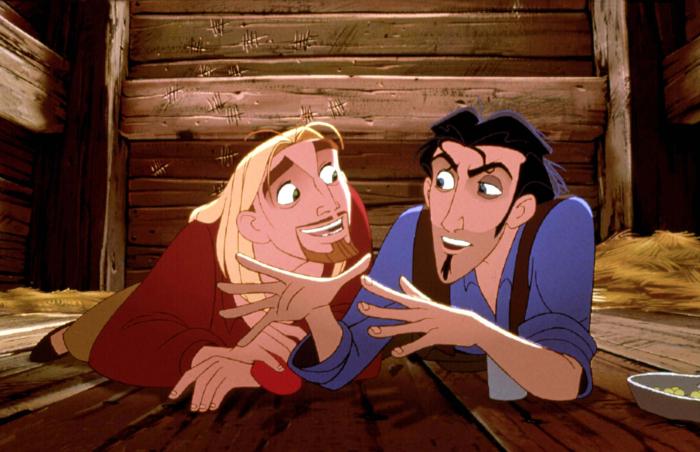
1) Tulio and Miguel from The Road to El Dorado


I see no reason to justify this. Who didn't develop a crush on one (or both) of these bromantic heroes? Tulio, the tall, dark, smart one. Miguel, the stocky, blond, happy one. As far as I'm concerned, if you didn't like one of these Spaniards, there's an issue here. Personally, I alternated between them. Tulio's more my look, and who doesn't love a Kevin Kline performance, but Miguel is just so sweet and unassuming (for a con artist)... and he's got that guitar.


Plus, neither one is ashamed to scream like little girls when necessary.


2) Clopin from The Hunchback of Notre Dame


This is the one that got me strange looks at the meal that inspired this post. But honestly! He's the narrator of a very underrated Disney movie, he's got puppets, he can sing, he can dance and do backflips, he's great with kids, and he's king of the gypsies of Paris. Plus, it's not every guy who can pull off fuchsia.


Okay, so he's kind of a semi-sadistic jerk and halfway through the movie shows hints of being a raving psycho. But he's just so much fun to watch. And I want those shoes. Okay, maybe I do have problems.

3) Nightcrawler from X-Men: Evolution


From weird to worse. Yes, he's blue. But if that bothers you, catch him with the image inducer on (which makes him look "normal," anti-mutant racists). Honestly, I was more bothered by that nineties-"fashion" they had him wear with his pants looking like they were always going to fall down. But that personality! Kurt is absolutely adorable as far as I'm concerned, plus he's funny and got that Clopin-acrobatics thing. He's got issues, but he's not angsty about them (I'm looking at you, goth-Rogue), and then there's the accent- I'm really starting to discover a pattern going here with my cartoon crushes, by the way.

4) Flynn Rider from Tangled


Okay, this one isn't a shocker. Who doesn't love this guy? Though I'll be honest, I prefer him when he's all snarky and being forced to dance than when he's all romantic and stuff.


Also when he's sneak-punching a horse.

5) Tack from The Thief and the Cobbler


Because there's always room in my heart for the shy ones, okay??????

If you're going to watch that movie, do NOT watch the theatrical release version. It was butchered. Watch the recobbled cut on YouTube. But that's a rant for another day.

So, cartoon crushes. I've confessed mine and yeah, maybe they're a little weird. But I'd like to think they're interesting. I know I'd have a better time in a rowboat with Miguel or Flynn than the Little Mermaid had with Eric.

Thursday, January 17, 2013

Disney for Your Twenties

First of all, completely inspired by this awesome tumblr.

Secondly, I know it's been a long while since I've last blogged. I'm trying to come up with a direction for this thing, instead of just me talking about whatever's in my head. So until I get that sorted out, posts will probably be more sporadic.

But anyhow, you know how it was growing up on Disney? So many people joke about how Disney lied to them, how we all thought we'd fall in love in three days when we were sixteen, how we all thought we'd turn out to be someone unbelievably special and save the kingdom (even if that kingdom is our bank account or our family or, I don't know, Idaho), how we all envisioned the hard work being sped through via musical number (what, you didn't picture that?).


That song is just so catchy.

But then we grew up and learned that it wouldn't be so easy. The thing that I've noticed is, there were other fairy tales we were told, mostly in High School and maybe the early years of college, which somehow managed to convince us that the work would be hard and thankless, and we'd mess up a lot... but if we got good grades and made those connections, we WOULD get what we always wanted, darn it! Because everyone ELSE in the literature class is a big phony who would end up serving coffee or working for the man, but not US! Because WE were in this for the long haul!

But then, and by then I mean now, we realized that maybe we were going to spend a few years serving fries with that, surfing procrastinating sites on our internship time, or making customer service phone calls, and it wasn't because we were insincere in our dreams or even unsuccessful or untalented.

It's just that, well, we've got to start somewhere. We've got to pay our dues. Even when it seems like the meanest, least talented person in our sculpture class got that huge commission because they've got a rich uncle. Why didn't THEY have to pay their dues?

I can only shrug. As I type this during my lunch break at my internship. Right before I go back to my apartment and do my laundry and obsess over my grad school tuition and whether or not I'm somehow disappointing people because I DIDN'T do that big solo art show or publish my novel or start a web comic or get married at twenty-one or make Aliyah right out of college or somehow change the world.

At various points I wanted to do all of those things, and I haven't.

YET.

I am twenty-four years old, at a place and location I never predicted or particularly wanted for myself. But you know what? I really can't complain. I'm still using my little bits of spare time to come up with new art pieces (the Kohelet piece is back from the framer's, by the way).


I still doodle little cartoons and wonder if they would make someone on the internet laugh. I still imagine making that half-a-story pan out into a book. I still think about what I might do someday. The only  difference is that I've got less of a deadline now, and more realistic expectations, because I acknowledge they might NOT happen, and that would actually be (mostly) okay. But that doesn't mean I'm going to stop trying.

I like this weird sort of semi-optimistic realism I've been experimenting with lately. Small goals. Finish one project at a time, get through one week at a time, try to do the right thing whenever I can, and try not to tick people off too much (although sometimes one of those last two precludes the other. REALITY BITES.).

And oddly, the idea of difficult choices is something the fairy tales were right about. I can't think of a (good) Disney movie where the protagonist just coasted by without at one point feeling trapped (I said GOOD Disney movie. And I happen to dislike the Little Mermaid, so please don't start with that one. Seriously, she suffers NO CONSEQUENCES for messing things up for everyone else. NONE. No. Lessons. Learned! Other than that you should give up your voice for a man and that a deal with the devil never hurts).

Aladdin had to be the Prince everyone wanted or admit being himself. Simba had to live carefree and let others suffer or face both his past and his uncle. Mulan had to risk her safety and reputation or her father's. Belle had to choose between giving up her dreams of seeing the world and her father's freedom. Hercules had to choose between immortality and a girl with seemingly no internal organs.

And these struggles, much more so than the happy endings and catchy tunes, made these movies relatable. It's at that moment where Mulan is abandoned by her troops on the mountainside or Aladdin's magic clothes are zapped away, or Scar forces Simba to confess his past where I pause and think, wow, well-drawn protagonist. I'm really rooting for you. Everything stinks for you. This is the bottom of the barrel on your journey. Everyone hates you and the bad guy is laughing and your little animal sidekick's jokes are at their corniest. And you tried so hard to make it work. You were so sincere in your efforts.

But this is Disney, so I know you're going to pick yourself up and save the kingdom. You just need to admit you're just a street rat, or save the emperor as (gasp!) a girl, or have a mandrill hit you with a stick.


It all starts with that common thread of facing reality and stepping forward anyway, shaking hands, hugging sidekicks who don't generally hug, and making the best of what you've got right now.

I think that's the key. Making the best of what we've got right now instead of dwelling on what could have happened if we hadn't gotten stabbed by a Hun or flattened by an Ionic column. And it starts with SEEING what we've got right now. We've got more than we think we do.

Friday, December 21, 2012

Little Truths

I've discussed words of wisdom several times: those nuggets of advice I've heard from school advisers, friends, TV shows, fortune cookies, and the like. But with this ridiculous semester finally coming to an end, I feel like my head is clear enough for the first time in months to look back and discover all the little things I've learned on my own, just by existing and living and watching the world move around me like I'm stuck in a shaken snow globe.

So here they are:
1) There are truths no one can teach you. These are the ones you have to find on your own. Anyone can tell you that the pumpkin flavored cupcake is the best, but you will not know it until you try that cupcake. Anyone can tell you that you will discover certain truths, but those things ARE NOT truths until you discover they are. For example:

2) Cliches are cliches for a reason. That saying you've heard a billion times over, the one that makes you want to scratch out your eardrums? There's a reason everyone says it. Usually, it's because on some level, it's true. Things like 'you'll never know until you try,' or 'everything happens when you least expect it,' ALL TRUE. But you only realize them, as I said in #1, if they've already applied to you.

3) Nothing builds your confidence like losing absolutely all of it. Sounds like nothing that makes sense, but it's true. If you're anything like me (or even if you just happen to be female, or human, heck), you've suffered from low self-esteem at some point. You went through a time when all you wanted was for someone to tell you you're pretty. And when someone did, you believed them. For two seconds, and then you went back to feeling like a waste of space.
But then somebody told you that you actually ARE a waste of space. And this wasn't a school bully or someone you dislike or even someone who was trying to hurt you. Somebody you either didn't know or cared about said something that reinforced your every self-loathing feeling, and made you lose every bit of confidence you had. Maybe they said it outright, maybe underhandedly. And you hit a low point.
But then even you took a look at yourself in the mirror and thought, no. I'm not worth nothing. I may not be worth much, but not nothing. And then you corrected yourself: no, I'm too cool, and nice, and happy to be not worth much. Heck. I'm worth quite a lot. And you start to build confidence. ACTUAL confidence that depends on nobody but you. Which brings us to:

4) There is no way to convince someone of anything (that matters). You can convince someone that the second Batman movie was better than the first. You cannot convince an anorexic person that she's not fat. You can convince someone that mashed potatoes taste better with sage butter than olive oil. You cannot convince your right-wing cousin that they should be left-wing if they actually care about politics. You can convince someone that the Hulk would beat Thor in a fight. You cannot convince a Rabbi to take up Catholic Priesthood, not if he actually believes in his religion. You cannot convince somebody broken and sad to suddenly be happy and whole. You cannot convince someone who thinks they're ugly that they're beautiful. If there's a truth they must discover, like that they're not hideous, or that their selfish behavior will only hurt themselves, or that nobody will believe the fiftieth lie in a row, they have to discover it themselves. There's no. stinking. way. around that. But with luck, they WILL discover it. And that's called maturity.

5) Emotion is not weakness. Crying may not look good. It may not be dignified. It may not be attractive or pleasant to watch or listen to. It may feel terrible. But it is not weak of you to cry or tell someone how you feel. Sometimes it's much easier to pretend nothing is wrong than to face it. When you feel like something's missing and you act like nothing's going on, that isn't strength. It's called DENIAL. Don't cry all the time, don't let it sit on you like a giant rhino storm cloud, maybe don't dwell on it longer than you should. But letting it get to you once in a while does not make you weak. It makes you honest, if only with yourself.